
When you put new SPC or vinyl flooring into a landed home, the staircase is often the part that gets left behind. The living room looks fresh and modern, and then the eye lands on old mosaic, terrazzo or worn tiles going up the stairs. In terrace and semi-D homes across Selangor, the staircase usually sits right in the middle of the house, so it matters more than people expect.
This guide covers how stairs are finished to match new floors, what treads and nosings are, how to match colour and pattern, what to think about for safety with children and elderly parents, and a few details from real stair projects, including glass railings.
Want your stairs to match your new floor?
Send us photos of the staircase from the bottom and the side, plus the number of steps. We’ll explain the options.
Staircase Flooring at a Glance
| Part | What it is | What to check |
|---|---|---|
| Tread | The flat part you step on | Fits the step depth; firm with no movement; slip-resistant surface |
| Riser | The vertical face of each step | Matches or contrasts with treads; neat joints at the top and bottom |
| Nosing | The front edge of each tread | Firmly fixed; rounded or square edge; visible and not slippery |
| Landing | A flat section mid-stair | Usually the same floor as treads; joins neatly with the nosing |
| Skirting / stringer | The side edge along the wall | Clean finish against the wall and railing |
Treads, Risers and Nosings
A staircase finish is made up of a few separate pieces.
Treads take every step, so they must be fixed firmly with no flex or movement. With SPC or vinyl, treads are usually glued directly to the existing step after preparation, rather than floated like the main floor.
Risers cover the vertical part of each step. They can match the treads for a seamless look, or contrast (for example, white risers with wood-look treads) for a crisper style.
Nosings protect and finish the front edge of each tread. They can be a matching profile that wraps the edge, or a separate trim. Because the nosing takes the most wear and is where feet land, it is one of the most important safety details on the staircase.
Matching Colour and Pattern to Your Floors
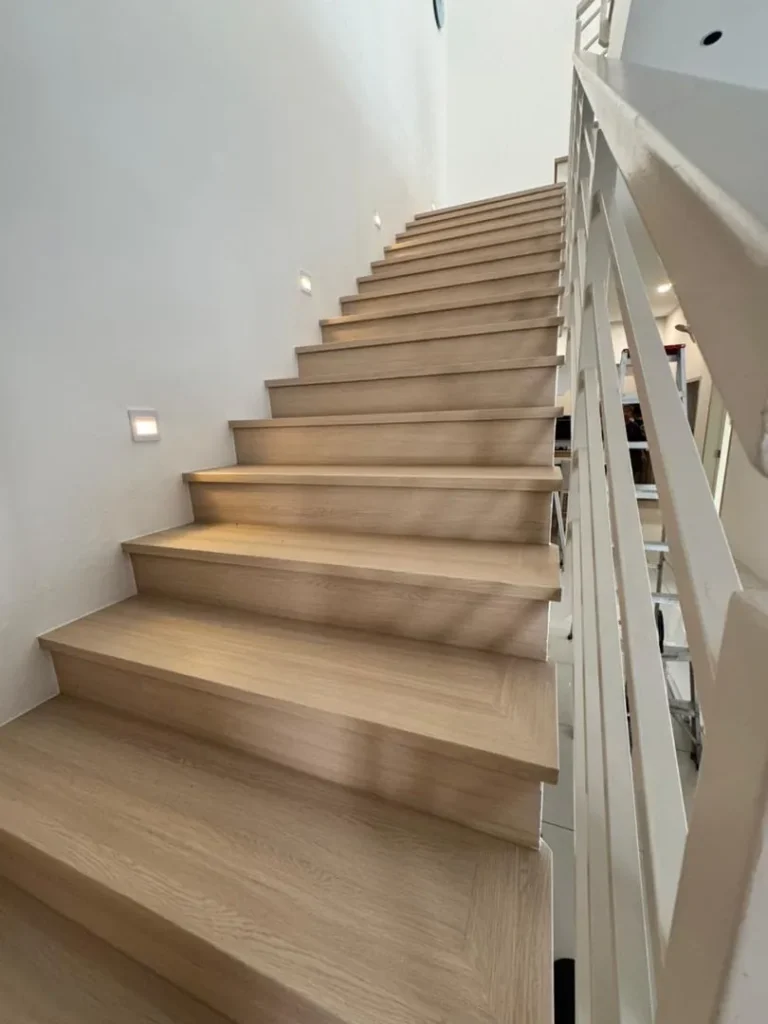
The easiest way to make a staircase look planned is to match it to the floors at the top and bottom:
- Same colour, same direction. Treads in the same wood look as the downstairs floor make the house feel continuous.
- Herringbone downstairs, straight stairs. Herringbone patterns cannot run up a staircase, so stairs are finished in straight treads in a matching colour. Our guide to herringbone vs straight-plank SPC flooring explains how the two patterns work together.
- Contrast risers. White or painted risers with wood-look treads give a lighter, modern look and can make each step easier to see.
- Landings. Use the same finish as the treads so the landing does not look like a patch.

Bring samples to the staircase itself. Light from windows and stairwell skylights can change how a colour looks compared with the living room.
Matching stairs to a herringbone or patterned floor?
WhatsApp us photos of your floor and staircase together. We’ll suggest a stair finish that looks planned.
Safety for Children and Elderly Parents
Stairs are where most home slips and falls happen, so safety deserves as much thought as looks:
- Slip resistance. Choose a textured or matt surface rather than a high-gloss finish on treads.
- Visible edges. A slightly contrasting nosing or a contrasting riser helps people see where each step ends, especially at night and for older eyes.
- Firm fixing. No tread or nosing should rock, flex or lift.
- Lighting. Step lights or wall lights at low level help a lot.
- Handrails. Every staircase used by children or elderly parents should have a sturdy handrail that is easy to grip.
Our guide to flooring for homes with children and elderly parents covers safety across the whole house.
Railings and Glass Details
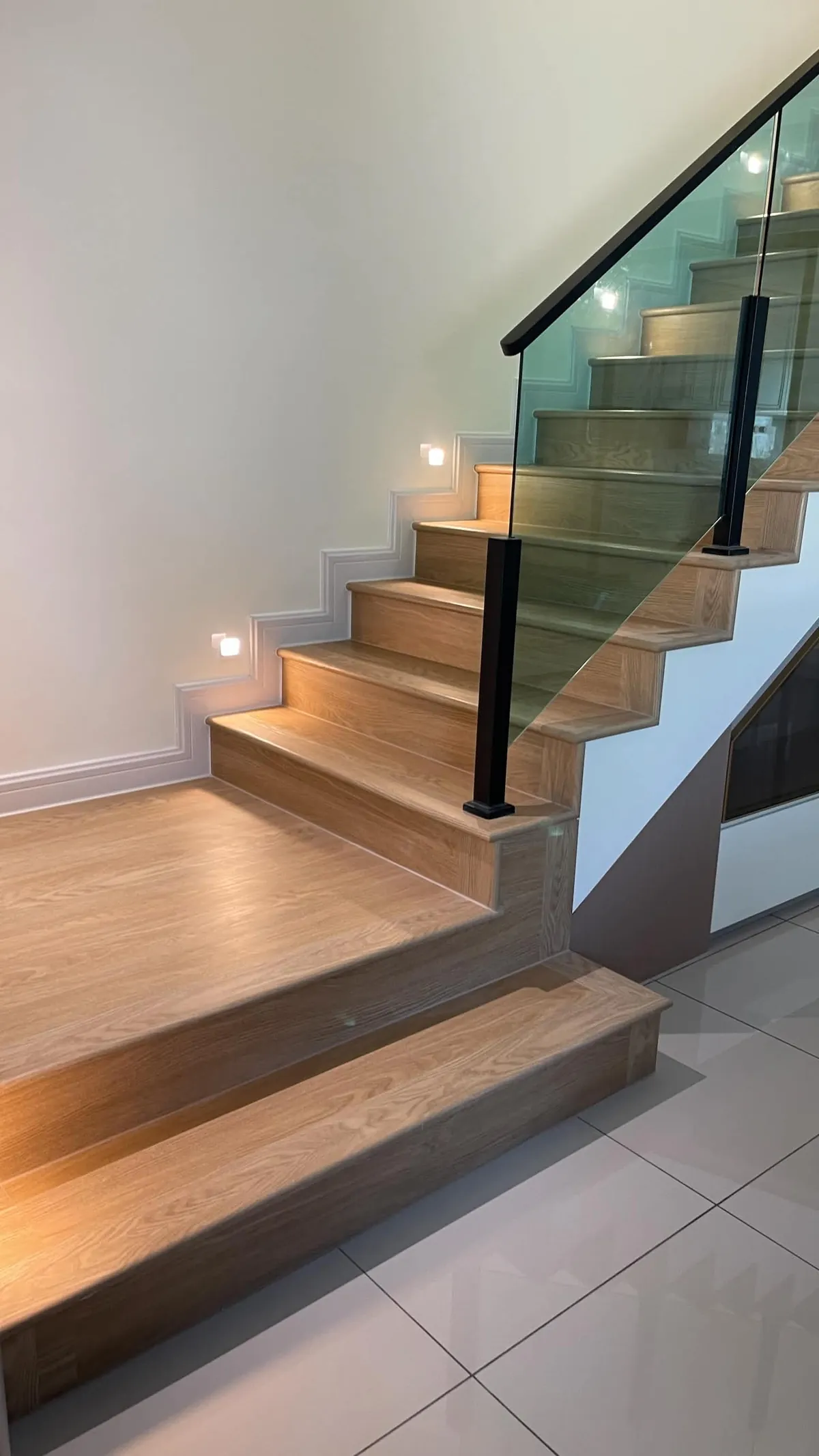
Many renovated stairs in Klang Valley homes pair wood-look treads with a glass railing or slim metal balustrade. A few details make the difference:
- Glass railings: check how the glass is fixed. Side-fixed or channel-fixed glass changes how the tread edge and stringer are finished.
- Metal railings: treads must be cut neatly around posts, with no gaps where dust collects.
- Open sides: where a stair has an open side, the visible edge of each tread needs a clean finish.
The hero photo at the top of this post shows wood-look treads beside a glass railing, a popular combination in modern terrace renovations.
When to Do the Stairs
Stairs are usually finished after the main floors, so the stair pieces can match the finished floor height at the top and bottom. Plan the stair finish together with the floor order, so the same colour batch can be used. Our guide to the installation process explains what happens on site, and the room-by-room guide for landed homes covers stairs alongside other spaces. To see the options we install, visit our SPC flooring page, or contact us to arrange a site visit.
Staircase Planning Checklist
- Number of steps, landings and any winders counted
- Existing step surface checked for loose tiles or damage
- Tread colour matched to the floors at the top and bottom
- Matching or contrasting risers decided
- Nosing type and fixing method agreed
- Slip-resistant finish chosen
- Railing type and fixing considered
- Lighting and handrail checked for safety
FAQ
Can SPC flooring be used on stairs?
Yes, with suitable stair treads and nosings. On stairs, pieces are usually glued and fixed firmly rather than floated like the main floor.
What is a stair nosing?
It is the front edge of each step. A nosing profile protects the edge, finishes it neatly and helps make each step visible.
Should stairs match the floor?
Matching the colour and grain to the floors at the top and bottom usually looks most planned. Contrasting risers are a popular variation.
Can new treads go over old tiled or terrazzo stairs?
Often, yes, if the steps are sound and can be prepared. Loose tiles or uneven steps need attention first.
Are vinyl or SPC stairs slippery?
It depends on the finish. Choose a textured or matt surface and good nosings, and keep stairs free of polish or cleaning residue.
Related guides
- SPC Flooring for Landed Homes: A Room-by-Room Planning Guide
- Herringbone vs Straight-Plank SPC Flooring: Style, Cost and Installation
- Choosing SPC Flooring for a Home with Children and Elderly Parents
- What Happens During SPC Flooring Installation?
- Skirting, Trims and Transitions for SPC and Vinyl Floors (Including Open-Plan Layouts)
Plan Your Staircase Finish
Send us these on WhatsApp and we’ll reply with the next steps:
- Your area (e.g. PJ, Subang, Shah Alam, Klang)
- House type (terrace, semi-D, bungalow)
- Number of steps and landings
- Current stair finish (tiles, terrazzo, timber, cement)
- Floor planned for downstairs and upstairs
- 2–3 photos of the staircase
What happens after you WhatsApp us
Reply → site visit → options → quote
- We reply with questions about your stairs and floors.
- We arrange a site visit in the Klang Valley to measure each step.
- We suggest treads, risers and nosings to match your floor.
- We send a quote with stair preparation and finishing listed.
Stairs, indoor flooring and outdoor surfaces across the Klang Valley.