
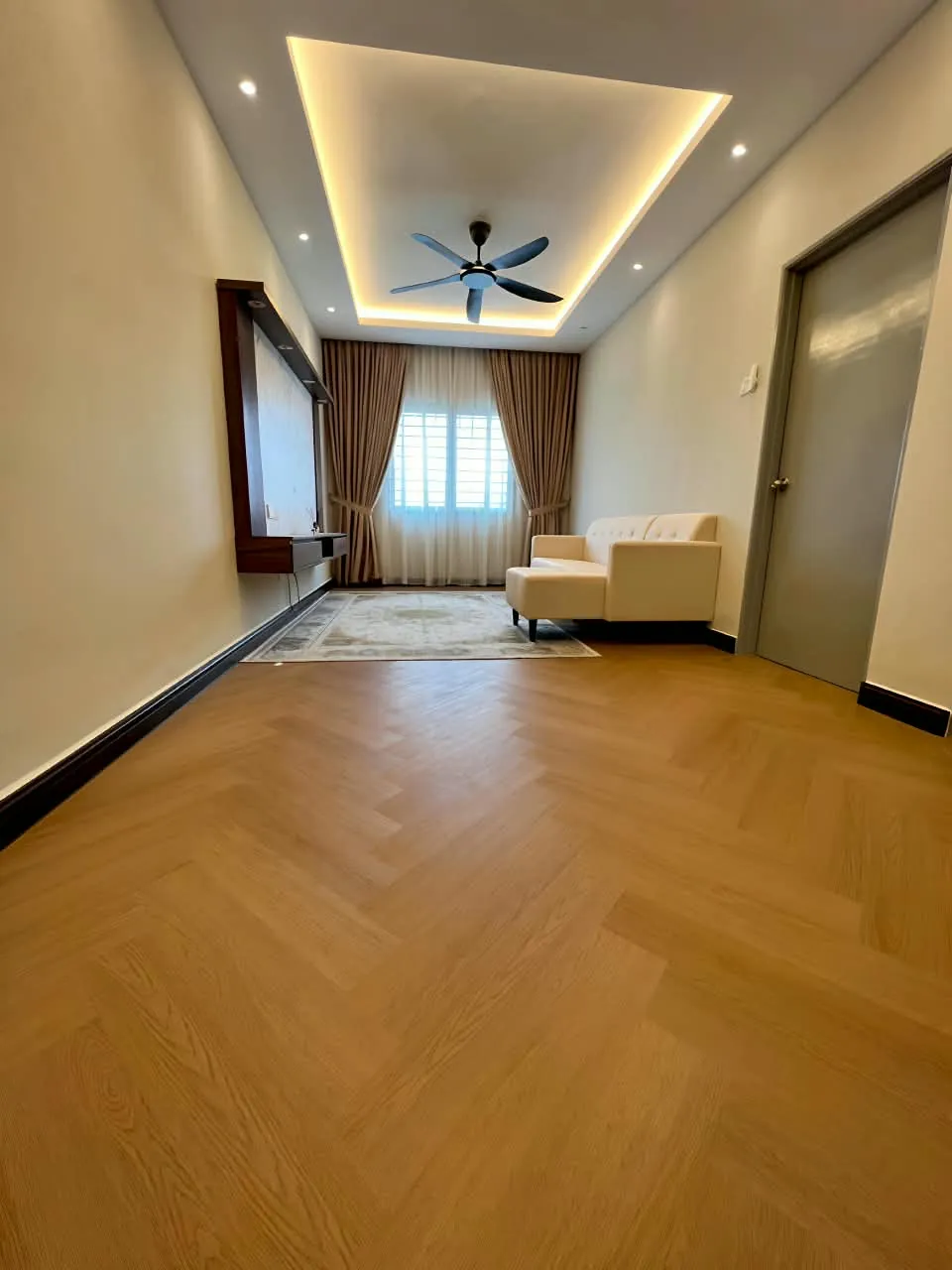
Herringbone has become one of the most asked-about looks for Klang Valley homes. It feels classic and a little special, and it photographs beautifully. Straight planks, laid in long rows, are still the most common layout, and for good reason: they’re calm, flexible and quicker to install.
Both layouts are available in SPC, so you don’t have to give up the practical side of rigid-core flooring to get the look you want. This guide compares style, what changes in your quotation, how installation differs, and which rooms suit each pattern.
Torn between herringbone and straight planks?
Send us 2–3 photos of the rooms and a rough floor plan. We’ll tell you where each layout works best and quote both options for the same area.
Herringbone vs Straight Plank at a Glance
| Factor | Herringbone SPC | Straight-plank SPC |
|---|---|---|
| Look | Zig-zag pattern; detailed, classic, feature-style | Long, clean lines; calm and modern |
| Room feel | Adds movement; can make a plain room feel designed | Can make a room look longer when laid along its length |
| Installation time | Longer; more planning and cutting | Shorter; simpler setting-out |
| Offcuts | More, especially around edges and corners | Fewer |
| Cost | Usually higher for the same area | Usually lower for the same area |
| Best for | Living rooms, halls, entrances, feature zones | Bedrooms, whole-home runs, condos, shops |
What Herringbone SPC Looks Like
In a herringbone layout, short planks are set at an angle to each other so the ends meet in a continuous zig-zag. Click-lock SPC herringbone usually comes as two matching plank types, often called A and B (left and right), that lock together to form the pattern.
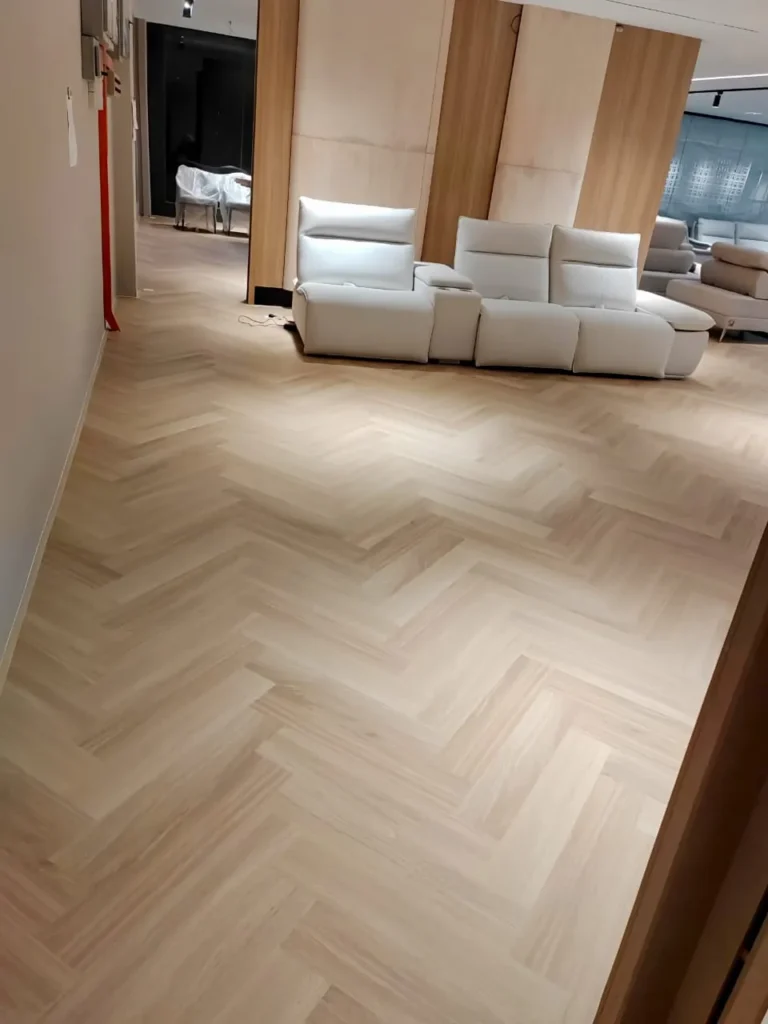
Why people choose it:
- It adds character. A herringbone floor can give a plain terrace living room or a condo hall a finished, designer feel without other changes.
- It suits classic and modern interiors. In light oak it looks fresh and Scandinavian; in honey or warm brown it feels more traditional.
- It works with grain and colour variation. The many short planks make natural colour differences look intentional, which also helps hide everyday marks.
Where to be careful:
- Busy rooms can feel busier. In a small room already full of furniture or strong patterns, herringbone may compete for attention. A lighter, low-contrast tone helps.
- Pattern direction matters. The zig-zag should line up with the main view of the room, such as the line from the front door to the back of the house. This is planned at the measurement stage.
The hero photo at the top of this post shows a honey-tone herringbone in a terrace living room, where the pattern runs towards the window and draws the eye through the room.
What Straight-Plank SPC Looks Like
Straight planks are laid in parallel rows with staggered end joints, like a traditional timber floor. It’s the layout most people picture when they think of wood-look flooring.
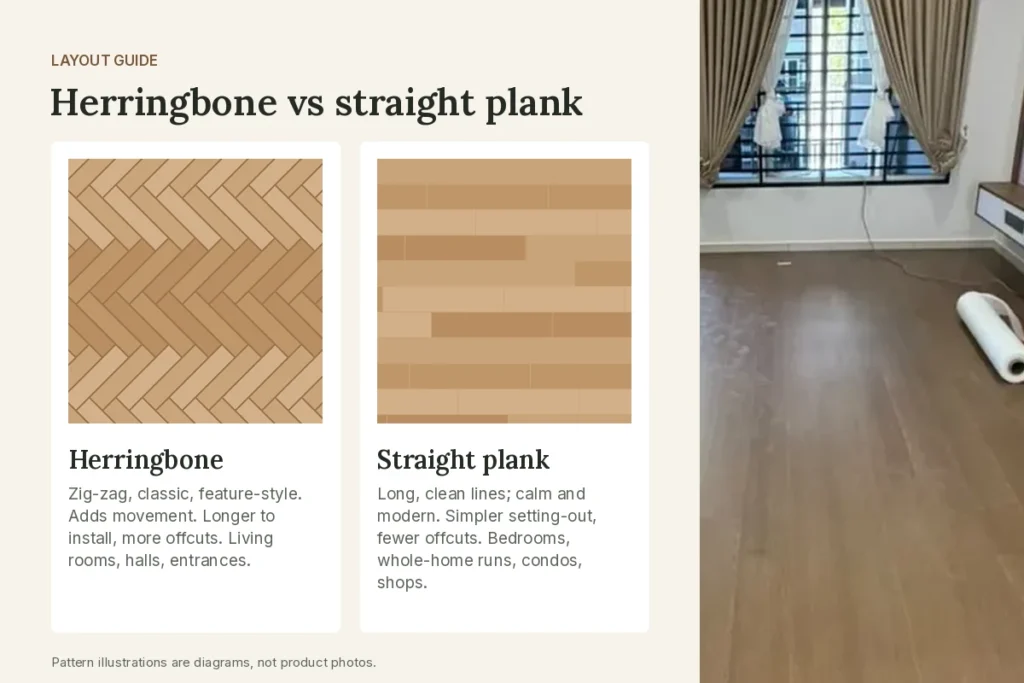
Why people choose it:
- It’s calm and easy to live with. Straight lines don’t compete with furniture, built-ins or wall features.
- It stretches a room visually. Laying planks along the length of a long terrace or a narrow condo living room helps the space feel longer.
- It flows from room to room. Straight planks can usually run through doorways and corridors with fewer breaks and trims.
Where to be careful:
- It can look plain in large open spaces. In a big, empty living hall, a flat colour in straight planks may feel a little flat. Choosing a design with visible grain helps.
- Joint layout still matters. End joints should be staggered properly so you don’t see a repeating “ladder” pattern.
What Affects the Cost of Each Layout
We don’t publish set prices, because every quotation depends on your rooms, floor condition and the design you choose. What we can explain is why herringbone usually costs more than straight planks for the same area:
- Labour time. Herringbone needs a centre line set out carefully and each plank placed at an angle. That takes longer than laying straight rows.
- Cutting and offcuts. The angled edges of a herringbone pattern create more cuts against walls, doorways and corners, so more material is set aside for offcuts.
- Product type. Herringbone SPC is made as shorter, specific A and B planks, and pricing is set per range. Our supplier HNK Flooring offers herringbone as well as standard plank designs, so ask us what’s available for your project.
- Room shape. Rooms with many corners, columns, bay windows or angled walls add cuts to either layout, but the effect is bigger with herringbone.
- Floor preparation. Both layouts need a flat, dry subfloor. Levelling or removing old flooring is quoted separately from the layout itself.
Want both layouts quoted?
Tell us the rooms you want covered and roughly how big they are. We’ll quote herringbone and straight plank for the same area so you can compare clearly.
How Installation Differs
The basic SPC steps are the same for both layouts: check and prepare the subfloor, lay the underlay where needed, click the planks together, then fit trims and skirting. The differences are in planning and timing:
- Setting out. Herringbone starts from a carefully measured centre line, so the pattern sits straight and looks balanced against the main walls. Straight planks start from one wall and follow the room’s longest direction.
- Doorways and transitions. Herringbone usually needs more planning at doorways, where the pattern either continues into the next room or stops at a trim. Straight planks run through more easily.
- Installation time. Expect herringbone to take longer than straight planks for the same area. We’ll give you an estimate for your rooms at the site measurement.
- Over existing tiles. Both layouts can often go over sound, flat tiles. Read SPC flooring over existing tiles for what we check first.
Which Layout Suits Which Room?
| Room or home | Layout that often works | Why |
|---|---|---|
| Terrace living and dining | Herringbone or straight, laid along the length | Herringbone adds a feature; straight planks make a long room feel longer |
| Entrance hall or corridor | Herringbone | A strong first impression in a small area |
| Bedrooms | Straight plank | Calm, simple and usually quicker to install |
| Compact condo | Straight plank, or light low-contrast herringbone | Keeps a smaller space open and uncluttered |
| Shop or office | Straight plank | Clean look, easier to plan around fixtures and displays |
| Whole-home renovation | Herringbone in living areas, straight planks elsewhere | Balances feature and budget |
For more planning ideas, see our guides to SPC flooring for landed homes room by room, SPC flooring for condos and light vs dark SPC flooring.
Questions to Ask Before You Confirm
| Ask your installer | Why it matters |
|---|---|
| Can you quote herringbone and straight plank for the same rooms? | It shows the real difference for your home, not a general rule. |
| Which direction will the pattern or planks run? | Direction changes how big and balanced the room feels. |
| How will doorways and room changes be handled? | Decide early whether the pattern continues or stops at a trim. |
| Is floor levelling or old floor removal included? | Prep work is often the biggest difference between quotes. |
| Are skirting, trims and underlay listed separately? | Makes quotations easier to compare line by line. |
| Can I see photos of a finished herringbone job? | Herringbone shows the installer’s setting-out skill clearly. |
| What warranty comes with this range? | Our warranty covers the product and the installation together; ask us for the terms for your range. |
Thickness matters for both layouts too. See 4mm, 5mm or 6mm SPC flooring, and browse the designs in our SPC flooring collection. If you would like a site visit or quotation, you can contact us anytime.
FAQ
Is herringbone SPC flooring more expensive than straight planks?
Usually, yes, for the same area. Herringbone takes more labour time and creates more offcuts from angled cuts. The exact difference depends on your rooms and the range, so ask for both layouts quoted side by side.
Can herringbone SPC be installed in a condo?
Yes. In a compact condo, a light, low-contrast herringbone often works best, especially in the living area. We check your floor and any building renovation rules at the site measurement.
Does herringbone take longer to install?
Yes. The pattern needs careful setting out from a centre line and more cutting at the edges, so it takes longer than straight planks for the same area.
Can I mix herringbone and straight planks in one home?
Yes. Many homeowners use herringbone in the living room or entrance and straight planks in the bedrooms. Transitions are usually placed at doorways with a neat trim.
Which layout makes a room look bigger?
Straight planks laid along the length of a room usually make it feel longer. A light herringbone can also feel open, as long as the colour isn’t too dark or high-contrast.
Planning Herringbone or Straight-Plank SPC?
Send us these on WhatsApp and we’ll reply with layout suggestions:
- Your area (e.g. PJ, Subang, Shah Alam)
- Rooms to cover and approx sqft
- Which layout you’re leaning towards, or if you’d like both quoted
- Your current floor (tiles, marble, cement)
- Who uses the space (kids, pets, elderly parents)
- 2–3 photos of each room
What happens after you WhatsApp us
Reply → measure → quote → install
- We reply with any follow-up questions and layout suggestions.
- Free site measurement, anywhere in the Klang Valley, with samples to compare in your own light.
- Written quotation listing product, underlay, prep, trims and skirting.
- Install planned with you once you’ve chosen your layout and colour.
One warranty covers both the product and the installation. Ask us for the terms for your range.