
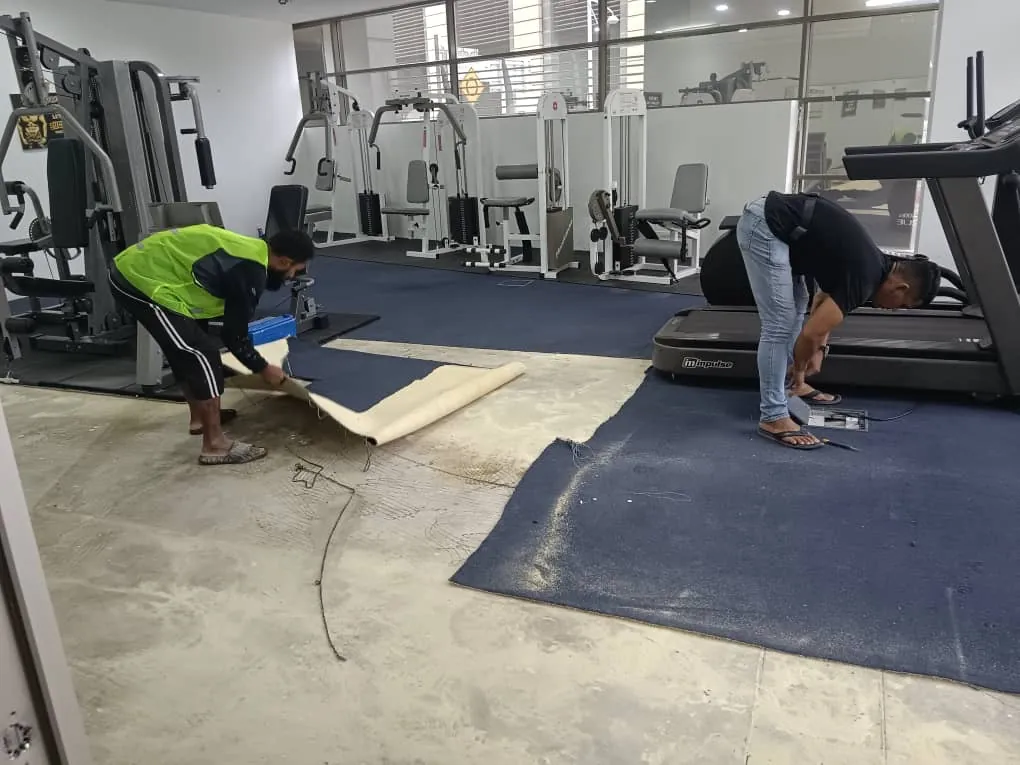
Many commercial spaces in the Klang Valley still carry floors from a previous tenant: tired carpet in an office, stained carpet tiles in a training centre, or old polished marble in a shoplot that once housed a showroom. When a business moves in or refreshes, the floor is often the first thing people want to change and the last thing they want to wait for.
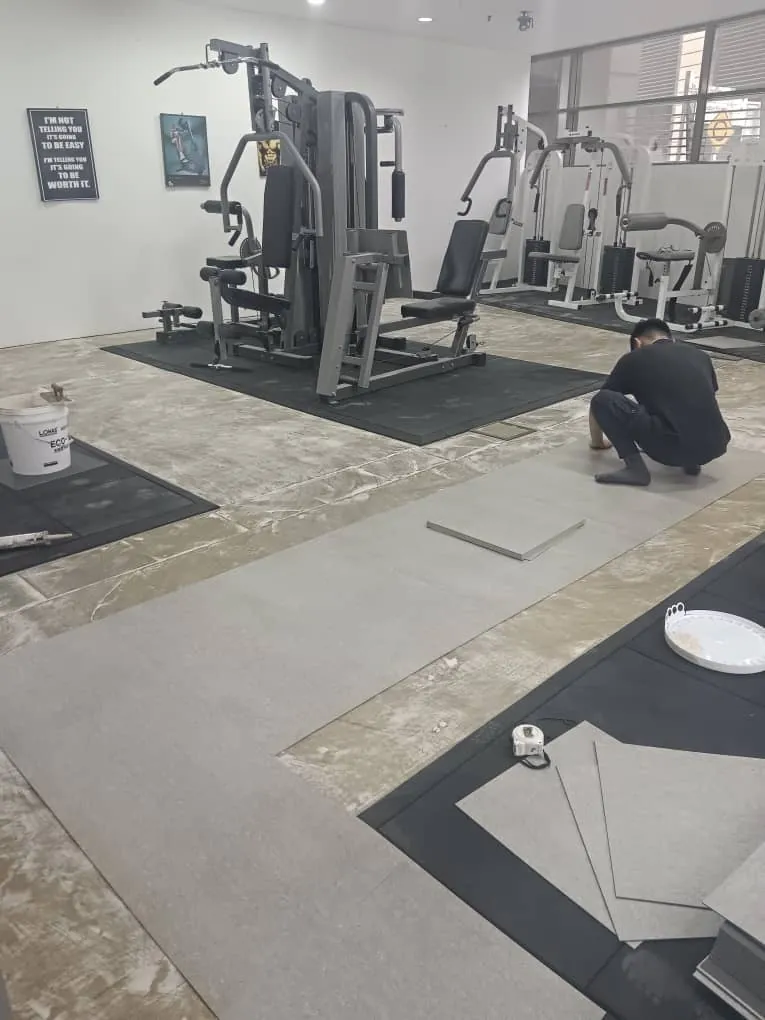
This guide follows the kind of renovation we did at a commercial gym: old carpet rolled up, the base checked, and light grey stone-look vinyl laid with black rubber mat zones, including over an area of old marble. It focuses on the renovation process. If you are still choosing materials for a fitness space, start with our guide to gym flooring: vinyl vs rubber mats.
Taking over a space with an old floor?
Send us photos of the current floor, the approximate sqft and when you need to open. We’ll tell you what the renovation may involve.
The Renovation at a Glance
| Stage | What happens | What to watch for |
|---|---|---|
| Survey | Measure, lift a corner, check what is underneath | Hidden damage, old tiles, moisture, uneven areas |
| Removal | Carpet, underlay and grippers taken up; debris cleared | Adhesive residue, dust, building rules on debris |
| Base check | Flatness, moisture, cracks, loose tiles or marble | Problems found here affect the finish later |
| Preparation | Grinding, patching, levelling, priming | Do not rush; it decides how the new floor performs |
| Installation | New floor laid zone by zone | Transitions, doorways, equipment zones |
| Handover | Clean, walk-through, return furniture or equipment | Check edges, joints and trims before reopening |
Before: Surveying What You Have
Old floors often hide surprises. Before giving a firm plan, an installer will usually want to see what is underneath:
- Carpet may be glued down or stretched over grippers, sometimes over old tiles or a rough screed.
- Carpet tiles usually lift easily but can leave adhesive behind.
- Marble may be sound and flat, or it may have hollow, cracked or loose pieces.
- Mixed floors are common, especially where previous tenants extended or partitioned the space.
Lifting a small corner of carpet in a few places, tapping marble or tiles to check for hollow areas, and checking a few spots with a straight edge gives a much better picture.
Step 1: Removing Old Carpet
Carpet removal sounds simple, but it creates more debris and dust than people expect. Underlay, gripper strips and adhesive all need to come up. In towers and malls, check building management rules for debris removal, lift use and work hours before starting.
Adhesive residue left on the base can affect how the new floor sits or bonds. It usually needs to be scraped or ground off, depending on the new product.
Step 2: Checking the Base
Once the old floor is up, the base tells you how much preparation is needed:
- Flatness. Vinyl follows the shape of the floor underneath, so dips and humps can show through.
- Moisture. Ground-floor slabs and older buildings can hold moisture, which may affect adhesives and the new floor.
- Cracks and damage. These need repair before installation.
- Old marble or tiles. If they are firmly bonded and flat, they may be able to stay as the base. Loose or hollow pieces need fixing first.
Laying a new floor over an existing hard floor is very similar to laying over tiles in a home. Our guide to installing over existing tiles explains the checks in more detail.
Step 3: Laying Vinyl Over Old Marble
In the gym project, part of the old floor was marble in good condition. Rather than hack it out, which is noisy, slow and creates a lot of debris, the marble was checked, prepared and used as a base for light grey stone-look vinyl. Rubber mats were then laid in the weight and machine zones.
This approach can save time and disruption, but it depends on the marble being sound, flat and clean, and on the vinyl product being suitable for that base. Polished surfaces may need preparation so adhesives or underlays perform as intended.
Wondering if your old marble or tiles can stay?
WhatsApp us close-up photos and a wider shot of the floor. We’ll tell you what we would check on site.
Keeping Downtime Short
For a business, every closed day costs money. These steps help:
- Phase the work. Divide the space into zones and complete them one at a time.
- Work outside trading hours where the building allows.
- Move furniture or equipment once, with a clear plan for where it goes during each phase.
- Order materials early so installation is not held up waiting for stock. Availability depends on the product and supplier.
- Agree the handover for each zone, so staff know when they can use it again.
Our guide to the installation process explains what usually happens on the day and what to prepare.
After: What a Good Finish Looks Like

At handover, walk the space with the installer and check:
- Joints are tight and edges are neat along walls
- Transitions at doorways and between zones are flat or properly trimmed
- No obvious bumps or dips showing through
- Rubber mat zones sit flat with no lifting corners
- Skirting and trims are fixed and clean
- Care instructions and product details are handed over
If anything feels hollow or noisy underfoot later, our guide to why floors lift, separate or make noise explains common causes. To understand how vinyl differs from SPC, see SPC vs vinyl flooring. To see the options we install, visit our SPC flooring page, or contact us to arrange a site visit.
FAQ
Can new vinyl flooring be laid over old marble?
Often, if the marble is sound, flat and clean, and the vinyl product is suitable for that base. Loose or hollow pieces need repair first.
Do I need to remove old carpet before installing a new floor?
Yes. Carpet, underlay and grippers need to come up, and adhesive residue usually needs to be removed so the new floor sits properly.
Can a commercial flooring renovation be done without closing?
Often, by working in phases or outside trading hours, depending on the building’s rules and the size of the space.
How long does a commercial flooring renovation take?
It depends on the area, the condition of the base and how the work is phased. A site visit is the best way to get a realistic plan.
Was the gym floor in these photos SPC?
No. The grey floor is stone-look vinyl and the black zones are rubber mats.
Related guides
Plan Your Commercial Floor Renovation
Send us these on WhatsApp and we’ll reply with the next steps:
- Your area (e.g. KL, PJ, Subang, Shah Alam)
- Type of space (gym, office, shop, training centre, other)
- Approx sqft
- Current floor (carpet, carpet tiles, marble, tiles, mixed)
- When you need to open or reopen
- 2–3 photos, including a close-up of the current floor
What happens after you WhatsApp us
Reply → site survey → plan → quote
- We reply with questions about the space and your timing.
- We arrange a site survey in the Klang Valley to check what is underneath.
- We suggest a removal, preparation and phasing plan.
- We send a quote with each stage listed.
Commercial and residential flooring across the Klang Valley, with phased installs for running businesses.